-
-
![Michael Rosen]()
-
CIO Insights are written by Angeles' CIO Michael Rosen
Michael has more than 35 years experience as an institutional portfolio manager, investment strategist, trader and academic.
RSS: CIO Blog | All Media
Drop (in the bucket)
Published: 09-15-2015Markets will fluctuate, as Pierpont Morgan caustically observed. And “fluctuate” means down as well as up. Perhaps I, too, am being caustically obvious, but I’ve long believed that a broad perspective on markets can often bring more clarity than myopic obsession.
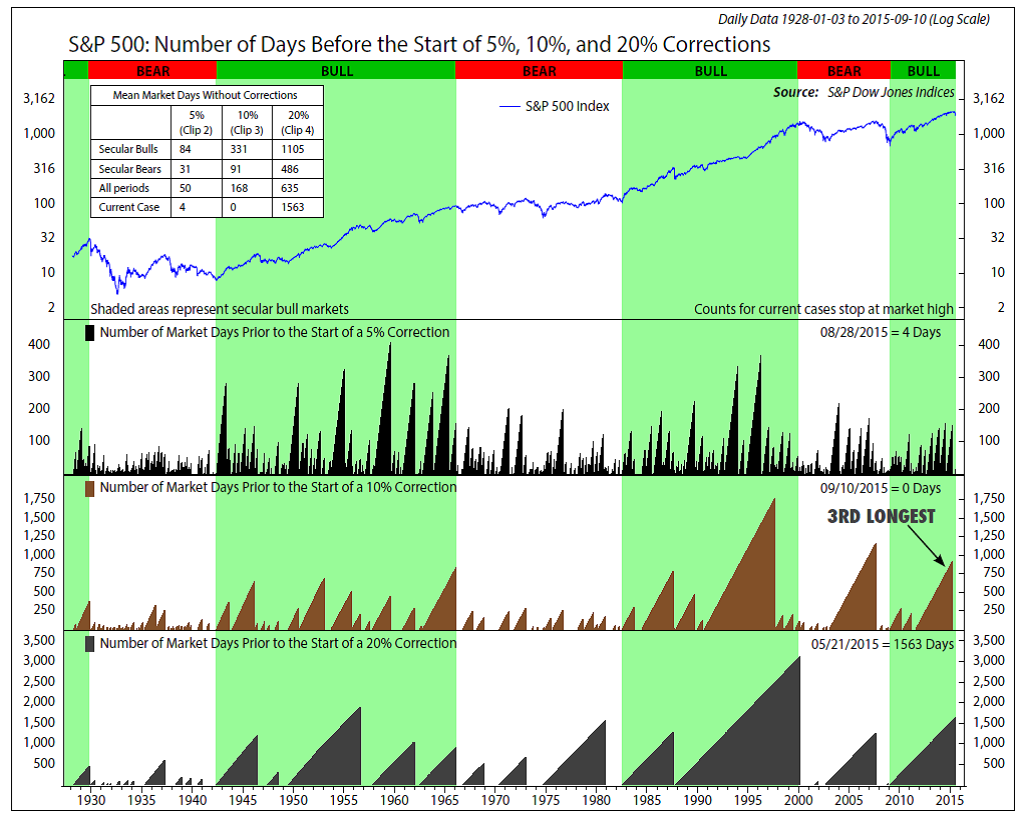
It was in 2011 that the S&P 500 Index last fell more than 10%, apparently beyond the memory of many investors who believed these corrections were relegated to ancient history, like buggy whips and handlebar moustaches. Last month the S&P dropped more than 6%, and between 21 May and 25 August of this year, declined 12.4%, ending the 3rd-longest spell (since 1928) without such a decline.
The graphic below (courtesy Ned Davis Research) plots the S&P 500 Index since 1928 (on semi-log scale) with the number of days between 5%, 10% and 20% declines. I’ll offer two observations: first, large corrections do seem to be occurring with a little less frequency than in the past, and secondly, the Index has risen from less than 5 in 1932 to around 2,000 today, declining frequently along the way. For long-term investors, the drop from 2,130 to 1,867 (May-August) is a drop in the bucket. It’s the move from 5 to 2,000 that really counts.
Print this Article-
![Reversal]() 21 Oct, 2014
21 Oct, 2014Reversal
Im interpreting the spike down last week and the strong rebound in the past few days as bullish. See the chart below ...
-
![Floating Oil]() 24 May, 2016
24 May, 2016Floating Oil
Oil has had a nice recovery this year (see graph for Brent, YTD), up about 18% to over $48/barrel today. Of course, this ...
-
![ÏÏÎ]() 6 Jul, 2015
6 Jul, 2015ÏÏÎ
I'm not sure why the pundits were predicting the Greeks would volunteer to walk meekly to their certain ruin, but the ...
-